Showing posts with label rgafriday. Show all posts

Sunday, 3 March 2019

RGAFriday - Experiments with gum Arabic and India Ink

I am new to RGAFridays and was intrigued by this week's session with Clare Buchta as it featured gum arabic as a masking fluid with india ink.  I've never knowingly played with gum arabic and thought this would be a brilliant opportunity to try it out and learn with others.

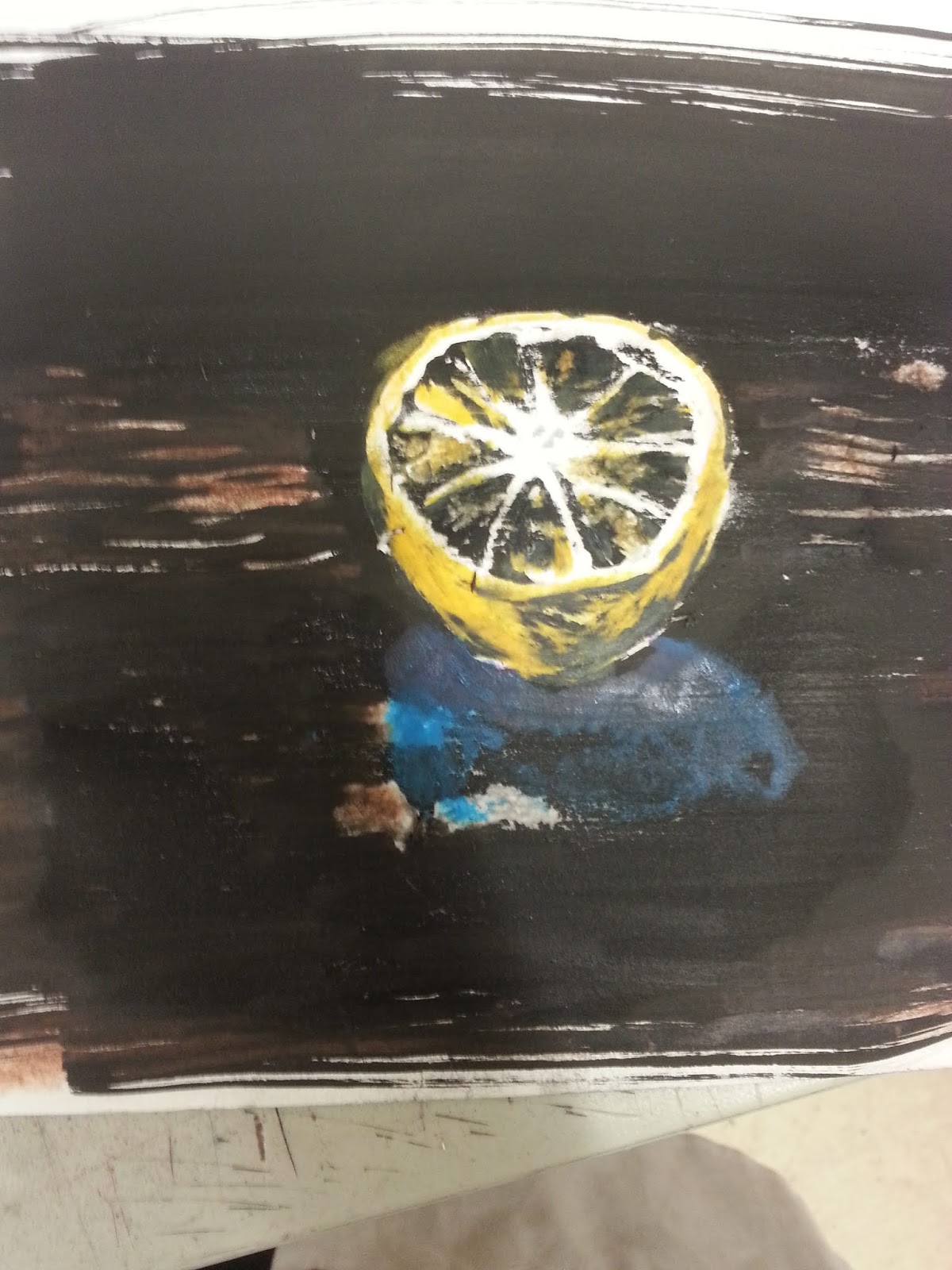
We painted with gum arabic (Clare suggested tinting with some watercolour so you can see what you are doing) on to paper that is ok to wash  - using fruits etc. as our inspiration. I took an orange half. 

We were to paint the bits we wanted to stay white - everything else would stay black. We could use our watercolour brushes, or any mark making implement like bamboo sticks that Clare had given to us.

Once the gum arabic had dried (with the help of a hair dryer), we painted over it using india ink 
note: do not use your precious watercolour brushes with india ink - it ruins them. 
There were two types of ink at the class -Winsor and Newton which seemed to give a black/almost sepia effect and also, Talens India Ink (brought in by Therese) that seemed to be really, properly black.

We waited for that to dry and then teased the gum arabic off under the tap gently with a brush that was only for the indian ink.

My experiments are below - I used textured watercolour paper, acrylic paper (that has an almost canvas like look, and smooth watercolour paper) - once the gum arabic was washed off, I used watercolours (Joan of Art), soluble wax crayons (Caran d'ache neo II) and some markers.
On textured water colour and lots of gum arabic marks. Realised that I had forgotten to mask out the orange skin. 
On acrylic paper done at the same time and so forgot the orange skin.


On smooth water colour - Messed up the marks in the segments but remembered to mask the orange skin

Again, seeing how people had used what they learned was fascinating. Here's one fab example of a pomegranate by Rosemary Harper

I looked up gum arabic section of Ian Sidaway's fantastic classes again in the watercolour course. Here's a link to the behind the scenes bit with him. Then found a few youtube videos about how you can use gum arabic to grlaze, bind, add the watery effect and promptly bought a bottle and put the India ink into the basket for later.

Yet again, the class was inspiring and am looking forward to March 15th's session with Emily Gillmor.  As they say on the site: "The cost per session is £6 for members and £7 for guests. An additional small charge is made if any specialised materials are needed or a model is involved. No need to book, just turn up. Everyone Welcome!"


Sunday, 24 February 2019

Going large on an RGA Friday


I've been an affiliate member of the Reading Guild of Artists since I met quite a few of them through the Urban Sketchers Reading group. Their 89th Annual Exhibition at the Reading Museum opens on February 27th 2019. Apart from exhibiting (if you are an exhibiting member), they run events, share opportunities and have various ways of joining in. They also run RGA Fridays which are fortnightly workshops during Autumn and Spring term-times and I went for the first time to attend "Enlargement to Abstraction with Cath Baldwin"

This intrigued me as I don't draw big - the largest being A4 as that's the biggest I'll do for urban sketching. Often my sketches are in tiny sketchbooks or A5/square notebooks that can fit into my handbag or pocket. I imagined this workshop would force me to draw really big but it did much more than that and I've been thinking about the lessons from this workshop since then.


The format

There were three workbenches set up each with different materials - one with flowers and foliage, one with fruit and vegetables (including a pungent onion that had been cut in half), and one with kitchen objects (metals) and I have to admit my heart did sink at this point as I don't really enjoy doing still life exercises as it reminds me of still life at school (and this was also set in a school). I'm glad I stuck it out here though.

We were asked to draw what we saw on A4 sheets of at least two of these workbenches using chalk, charcoal and india ink and concentrating on different ways of mark making to convey texture e.g. using different angles and tools. It was quite interesting to make different marks esp using different brushes and a wooden skewer (both ends) with the black ink. She warned us we were going to rip these drawings up for use in the next part. That intrigued me and I rather looked forward to that.

Stopping and looking at our and other attendees' work was very useful to encourage/inspire us and I know that my second sketch was of more interest to me than the first.

We looked at our drawings and Cath demonstrated the tearing of our sketches. We were asked to focus on interesting marks within our sketches in order to make a collage of the details we found. 

collage of torn parts from the initial sketches

Cath then encouraged us to zoom in on a part to enlarge and here's where it got really interesting. She went over why it wasn't simply going to be a magnified thickness to the lines and that we would have to look carefully at the line when enlarged as there would be textures appearing in these e.g. a brush line may seem solid but has the finer details of each fibre when inspected closely. We would have to maybe use different tools to convey the same interesting lines in their larger aspect. 

This was unexpected to me but obvious once she said it. She gave us a frame to help us (though Therese did point out to me later I could have just used photos and 'zoomed' in- another obvious lesson).


area I wanted to zoom in on with frame as an aid
We then moved on to A3 pages and started on these details. And this was hard for me but also fascinating. It was correct to call this workshop "Enlargement into Abstraction" as that is what some of our works would end up like.  
The largest piece (A3)

The enlargement (L) next to the original collage with frame (R)
Though I was disappointed when I realised we would 'only' enlarge up to A3, this quickly turned to relief because what I learned in the process was invaluable.

At the end of the workshop, I realised, it wasn't simply a matter of projecting on to a larger surface and drawing, as I had imagined (and even done in the past) - in order for the piece to retain its interest at a larger scale, I would have to pay closer attention to the marks that made the initial sketch interesting (including the negative spaces in the brush marks). This could even mean using different tools and techniques than the ones used in the initial sketch. Something my mind is still mulling over.

Many thanks to Cath and RGA Friday for this enlightening workshop.